Foujita Tsuguharu in European Art, 2025
This series of paintings by Heimler & Proc places the portrait of Tsuguharu Foujita within emblematic works by major European artists. In each composition a Sphynx cat appears beside him, serving as a symbol of modernity and an embodiment of Foujita’s eccentric character, long associated with feline subjects and with a uniquely flamboyant presence in the art world of his time.
Through these deliberate insertions, Heimler & Proc establish a precise dialogue between the Franco-Japanese master and the European pictorial tradition, affirming both artistic lineage and the contemporary force of Foujita’s singular vision.
Separation (76 cm x 61 cm)
Separation places Foujita within the visual language of Vincent van Gogh’s self-portraiture, replacing Van Gogh with the Franco-Japanese artist.
The work reflects Foujita’s complex relationship with Japan and his desire to achieve recognition in his country of origin. Its connection with Van Gogh adds another layer: Van Gogh’s celebrated Sunflowers is held by the Sompo Museum of Art in Shinjuku, Tokyo — the district in which Foujita was born — and the museum has also exhibited Foujita’s work.
Through this encounter, Heimler & Proc connect two artists whose identities and careers were shaped by relationships extending beyond the cultures into which they were born.
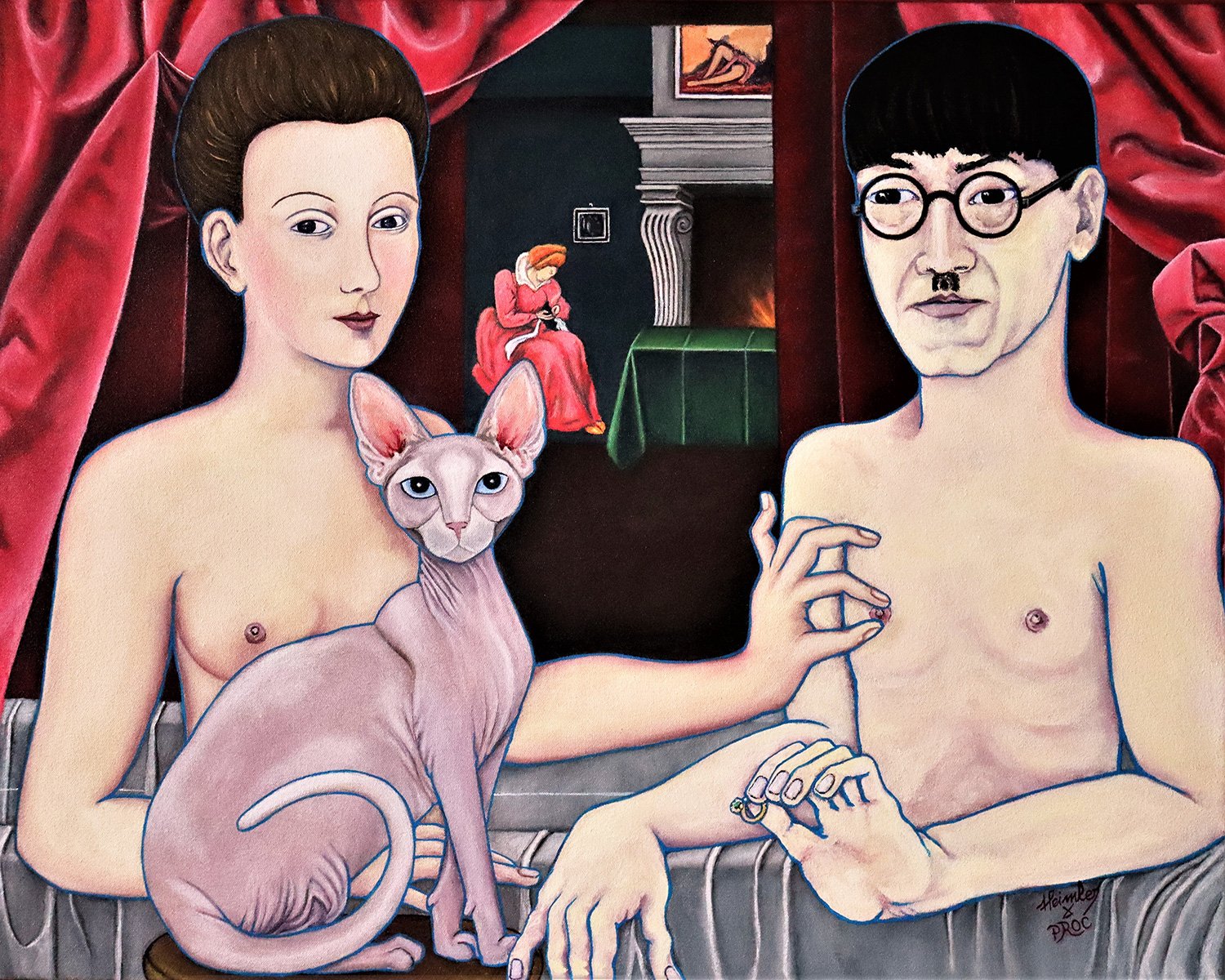
Ars longa, vita brevis (61 cm 76 cm)
Ars longa, vita brevis reimagines the enigmatic Portrait of Gabrielle d’Estrées and One of Her Sisters from the School of Fontainebleau, now held in the Louvre.
The composition retains the intimate, theatrical framing of the original, with rich crimson curtains surrounding two nude figures seated side by side. In place of Gabrielle d’Estrées appears Tsuguharu Foujita, his distinctive dark hair and glasses immediately recognisable. His ring-adorned hand reaches towards his companion, suggesting a symbolic union between Eastern and Western artistic traditions.
At the centre of the scene sits a Sphynx cat, its elegant, hairless form bringing the composition into the present while recalling Foujita’s enduring fascination with felines. Beyond the figures, a glowing fireplace, a woman in a red gown and a framed image above the mantel echo details and the underlying sensuality of the original painting.
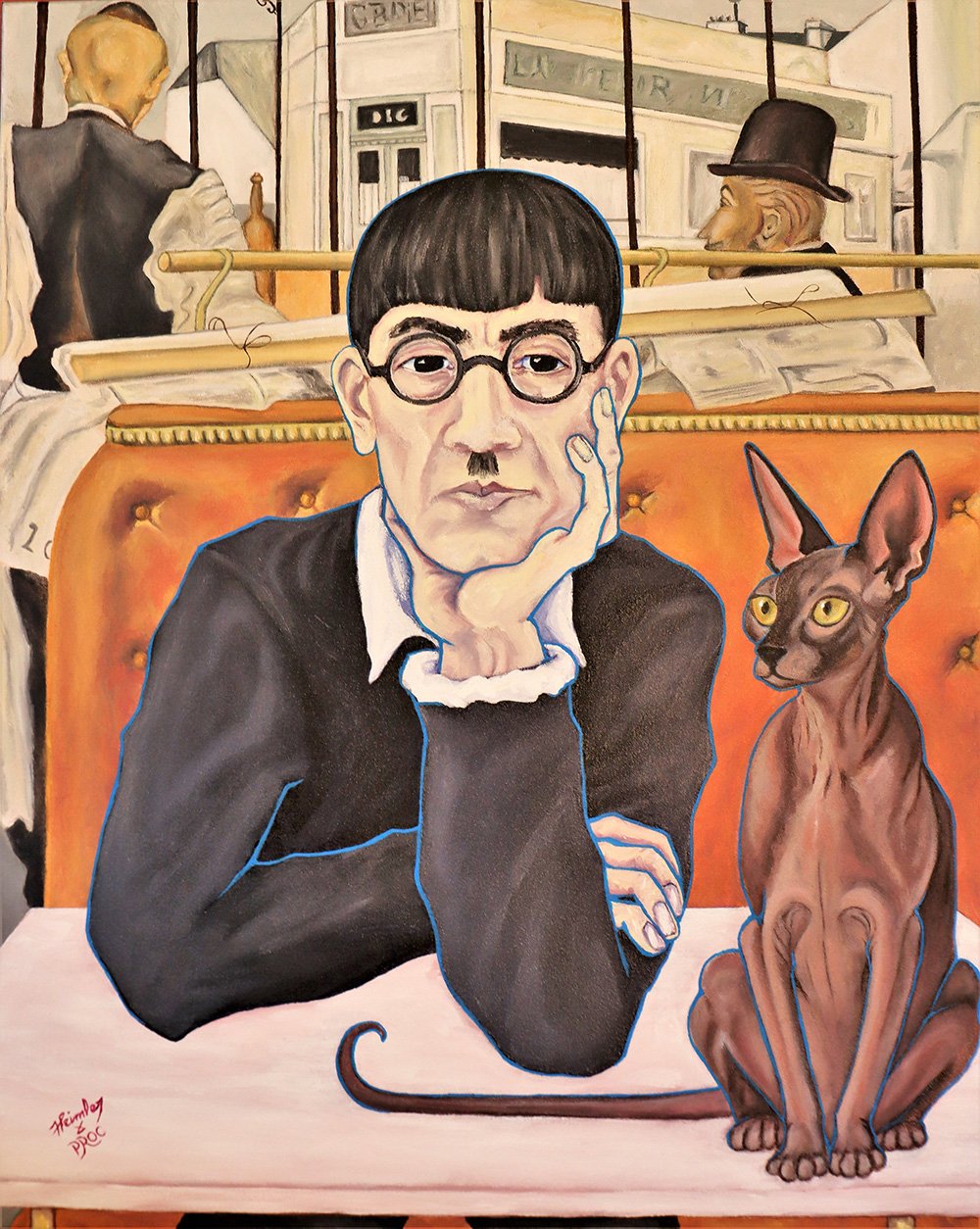
Cafe (76 cm x 61 cm)
Café reinterprets Foujita’s painting of the same name, replacing the female figure of the original with Foujita himself. Seated in contemplation against the rich orange upholstery of a café booth, he is accompanied by the Sphynx cat that appears throughout the series.
Behind them unfolds a lively Parisian café scene, recalling the nightlife and bohemian society depicted by artists such as Henri de Toulouse-Lautrec. Elegantly dressed figures converse in the background, placing Foujita within the cosmopolitan world of Paris that became central to his artistic life.
Through this reversal — the artist taking the place of his own model — Heimler & Proc reflect on Foujita’s position within the European avant-garde and the cultural life of his adopted city.
Closeness (76 cm x 61 cm)
Closness brings Tsuguharu Foujita into dialogue with the expressive world of Egon Schiele. Foujita occupies the centre of the composition, encircled by a female figure drawn from one of Schiele’s watercolours. Her lithe form, teal garment, black stocking and vivid red hair introduce the sensuality and psychological intensity associated with Schiele’s work.
Between them rests the recurring Sphynx cat, its alert gaze and poised presence recalling Foujita’s lifelong fascination with felines and their frequent appearance as companions and muses within his work.
The woman’s intimate embrace, Foujita’s restrained presence and the watchful cat create a scene that is both tender and enigmatic, bringing together Foujita’s fascination with women and cats and Schiele’s exploration of intimacy and desire.
On Olympia’s Bed (61 cm x 76 cm)
On Olympia’s Bed places Foujita within one of the defining works of European modern art: Édouard Manet’s Olympia. First exhibited at the Paris Salon in 1865, Manet’s painting challenged artistic and social convention through the direct gaze and unapologetic presence of its reclining nude.
Heimler & Proc reimagine Foujita within this iconic composition, accompanied once again by his Sphynx cat. The pairing reflects Foujita’s own position between artistic traditions: a Japanese-born artist who established himself within the European avant-garde while developing a distinctive visual language that combined Eastern and Western influences.
Here, the cat becomes more than a companion. Its independent character echoes Foujita’s own individuality and refusal to be confined by conventional artistic boundaries, positioning him within a lineage of artists who challenged the traditions of their time.