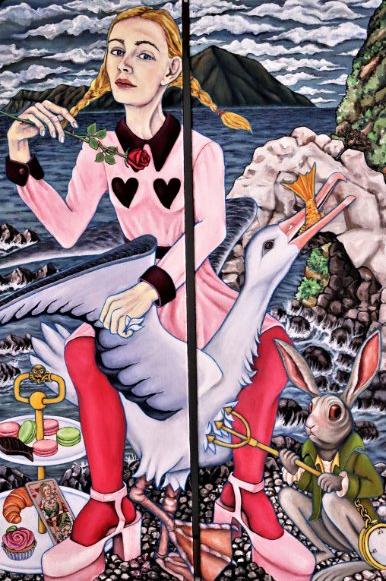
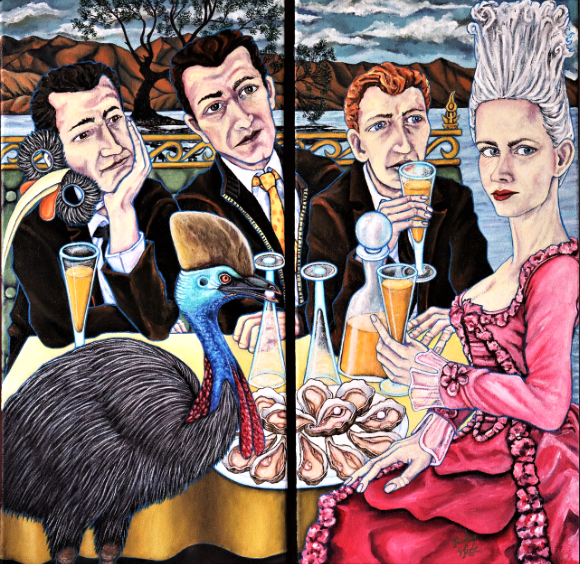


Titanic Survivors (169 x 110 cm)
Alice in New Wonderland (120 × 82 cm)
The Pretenders (92 × 93 cm)
The Last Dinner at the Chateau
In The Last Dinner at the Chateau, European architectural heritage encounters the raw, elemental landscape of Aotearoa New Zealand. Set against the volcanic terrain of Tongariro National Park, the nineteenth-century Chateau appears at once monumental and strangely displaced—a fragment of another cultural landscape transplanted into an environment of geological time.
The building’s presence is further charged by its uncertain future. Closed because of the need for earthquake-strengthening and awaiting the investment required for its restoration, the Chateau becomes more than an architectural subject: it becomes a symbol of impermanence. The title evokes the possibility of a final gathering, transforming an apparently convivial scene into one tinged with absence, uncertainty and loss.
Among the volcanic forms, the pink flamingos introduce another layer of displacement. Their vivid, improbable presence functions as a metaphor for intrusion and migration, echoing the Chateau itself. Both architecture and birds become foreign presences within the landscape, raising questions about belonging, transplantation and the human impulse to carry fragments of the familiar into unfamiliar places.
The painting's tension lies in these encounters: European and Aotearoa, constructed and geological, permanence and fragility, belonging and displacement. The Chateau, once a place of hospitality and gathering, now stands suspended between past and uncertain future.
And so the title carries a quiet irony. The Last Dinner at the Chateau may be a farewell—or perhaps simply a moment before another chapter begins. The painting leaves the question deliberately unresolved.